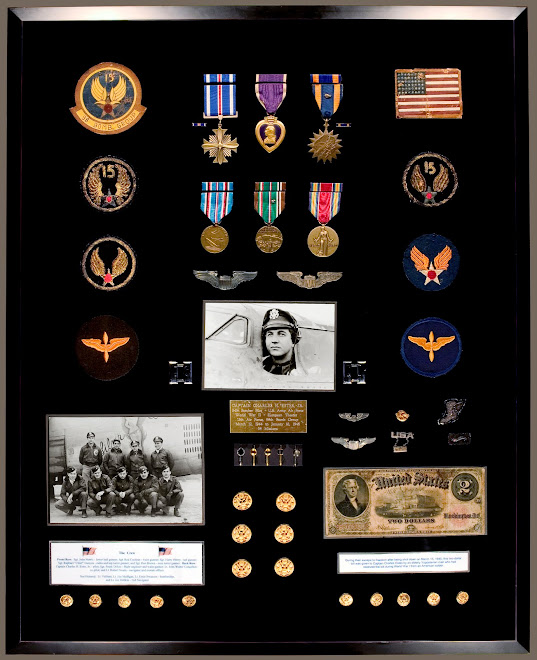
(Continuation of Captain Charles Estes's War Memoirs)
"Well, we all agreed on that and Swain indicated that there
was a little town up about 50 or 60 miles in front of us
named Prnjavor, and that if we were able to bail out
there he thought everything would be fine; that it
was indicated to him in his briefing that that was
not enemy territory but friendly territory.
So I got the crew all ready and everybody knew where
they were to go, so when we got close to Prnjavor I
gave the word for them to bail out, and everybody
scuttled to their point to bail out from. And of course
that was 12 men bailing out of an airplane that was
flying two engines,and so that lightened the airplane
to a great degree, ton maybe; and that made a lot
of difference in the ability for the plane to fly, so it
flew pretty well after that.
I had it on auto pilot, and when John and I left the
pilot and copilot seat and went down onto the flight
deck where we were to bail out from, we made it out,
and bailed out and believe it or not our chutes opened
and we floated down to dear ol' terra firma.
And when I landed there was an old Yugoslavian woman
running towards me, and I could hear her yelling,
"Oh, my goodness. Oh, my goodness." I sat up
and looked across the field and here came this old
Yugoslavian woman running over to me as fast as
she could come, her skirt pulled over her knees so
that she wouldn't get tangled up. When she got to
me she said, "Are you okay?" And I said, "Yeah, I
think I'm going to do all right." And she helped me
up, and I'll never forget that wrinkled face looking
down at me with so much concern. I didn't
know who she was or anything about her,
but she helped me out of my parachute.
And I had no use for it so I told her if you
have any use for this parachute then I give
it to you, and was just overjoyed with my
gift. And she led me to a path that went into
Prnjavor.
Well, while this was happening to me, Swain
came down in a field very close to where I was
and he was greeted by three soldiers each with
a gun, and each with a gun trained on him,
and he pointed to the American flag on his
jacket and lowered their guns. Now when
Swain landed he landed in a plowed field and
turned his ankle and he couldn't walk, so these
three soldiers between them carried Swain into
Prnjavor.
We all met later. But John Congleton he came
down in a field similar to the one that I landed
in and as he was struggling to get out of his
parachute shroud lines, and he finally made it
and he stood up and he heard something behind
him that sounded like a gun being cocked, so he
turned around and there was this young
Yugoslavian kid sitting on top of a fence and
he had a rifle pointed right at ol' John, and
John pointed to the American flag on his
shoulder, and the young kid jumped down
off of the fence and ran over to John and
hugged him on the legs.
And those were the only three landings that
I have any recollection of. The other men
when we finally got together we didn't really
and truly go over anything like that, and after
I got home from the service I didn't hear from
anybody, so I don't know what happened to them;
but we all were brought back to Prnjavor and to
this central office. It turned out to be a communist
office and it was run by this ol' colonel who I
think was an Italian."
(To be continued.)
Sunday, October 24, 2010

Monday, October 4, 2010
Flying on a Wing and a Prayer
(Continuation of Captain Estes's War Memoirs)
"Well, we hadn't been on the bomb run too long
before a big burst of flak hit the left engine number
one outboard, and we had to feather it. John
Congleton was right on the ball; he knew exactly
what was going on and what to do, and so he
did what he had to do and that engine was
feathered and we continued on the bomb run.
And then the bombardier indicated that the
bomb bay doors be open and they were opened,
and shortly after that we dropped our bombs
and rallied to the left. And as we rallied, the
right outboard engine number four was
hit, and John had to feather it, and we were on
two engines and we couldn't continue as the
lead of our formation; so we dropped out of the
formation, and just hoped that we could choose
the right manifold pressure and everything else
to carry our plane as far as we could go. We
were going to continue on the course that we
originally would have flown had all our engines
been running.
And that carried us to the foothills of the Alps,
but we had lost considerable altitude because
we couldn't continue to hold altitude at
altitude with just two engines; we were losing
about 5, 6, 700 feet a minute, and finally we
got to Yugoslavia. As we passed Zagreb we
picked up some flak and they were pretty much
on target. It sounded like hail on a tin roof, and
we were getting shrapnel from the aircraft guns
that were shooting at us.
After we past that point we were at about 8,000
feet and we were approaching the Alps. And I
called to Swain and asked him what was the
highest altitude of any peaks in the Alps on our
course, and he indicated 8,000 feet. Well, the
Alps were covered over with clouds, and I couldn't
see the peaks, but we knew they were there and we
knew they were at the same altitude we were; so
I couldn't afford to try and pick my way through
something that I couldn't even see where I was going.
So I turned left or south towards Sarajevo which was
not even known then hardly because the Olympic
games hadn't been played there, and there was no
airport there or anything else. We turned in that
direction and it became evident that there wasn't
any reason for us to continue going south; we couldn't
go north, that would carry us back into enemy territory,
and we certainly didn't want to turn back to the east
and go back into enemy territory again. We couldn't
go west because that would carry us right into the
Alps, so I told John that I thought that our best
chance was to get everybody ready and bail the
crew out and take our chances on the ground because
our chances in the air were no good."
(To be Continued.)
Mission 34: Schwechat Oil Refinery
This map depicts the target which is located at the
top of the map: Vienna, Austria - Schwechat Oil Refinery.
After their bombs were released the number one and
two engines were hit. They passed over Zagreb and
bailed out over the small town of Prijedor, Yugoslavia.
(click on picture to enlarge)
 Aerial view of Schwechat Oil Refinery - Vienna, Austria

Photos of the bombs being
released


Tuesday, September 28, 2010
The Mission: Schwechat Oil Refinery
(Continuation of Captain Charles Estes's War Memoirs)
"So after we had lifted off we started to make a slow turn
to the left and the planes behind us turned off a little quicker
after they got off of the ground, and they started their climb
and they fell into place in our formation, and we were on
our way to Austria. I don't know the exact time of the mission
that it took, but it probably was about an eight-hour mission
from the take-off to landing.
We crossed the Adriatic and we had the Alps in front of us
and we were high enough by then that there was no danger
of the Alps being below us. We were well above 'em and we
went over 'em about 12,000 feet, and we continued to climb
until we got to our initial point, and at that point we turned
onto the target run which would carry us over our target,
and we'd hopefully drop our bombs and they would land
in the right place and do the right damage.
I had been assigned a bombardier, Ernie Swanson, who came
from another crew. He was assigned to us for this particular
mission because we had no bombardier. Our flight engineer,
Frank Delois, was unable to fly because of illness and
Sgt. Scott took his place. And we had another
man that served on our crew, he was Jim Mulligan. He was
in the back and his job was to watch the formation and keep
them in close. And he was the only one that could speak on
the air while we were in progress. Radio silence was kept
unless he saw something that needed to be attended to,
and then he could come on and tell them to get in formation,
or pull in closer or do something that was being done wrong.
We had another man that was assigned to us. He was a
warrant officer. His name was Joe Dopkins. He was a
navigator, and I think that he was assigned to us more
as maybe his first mission or to learn something about
what went on on a mission so that he could be a
navigator for another crew or the crew that he was on,
but would have the experience of having flown a mission.
Other than our regular crew, that was the only additions.
When we got to the IP we turned left and headed onto the
target and that's when we realized that we were really going
over a hot spot because the flak was something awful;
it was these black little smoke puffs coming up in front of you
everywhere, and I was not on automatic pilot. The Norton
Bomb Site was so designed that I could put it on the automatic
pilot and the bombardier was then in control of the airplane,
but it was pretty rough, and I determined that it would be
better that I fly the airplane down the bomb run, and so
I did.
I had an instrument on my panel that was the PDI,
Pilot's Directional Indicator. Whenever he made an
adjustment on his bomb site, this instrument recorded
that change and I could make a turn to the left or the
right or make a slight adjustment to the left or to the
right and keep on track and on line to the target."
(To be Continued.)
Wednesday, September 15, 2010
The 34th Mission - The Mission they would remember for a Lifetime.
(Continuation of Captain Charles Estes's War Memoirs)
"Well, this was our first lead mission and everybody on the
crew was real nervous about it because we didn't -- we had
no experience with leading a mission, and we were unsettled
as to our ability to do it, but we felt like we could, and they
felt like we could, so we were assigned the duty to fly the
lead.
And the morning that we were to fly this mission, March 15th,
1945, those in my tent, John Congleton and Bob Swain and
myself, we were awaken by the sound of this orderly coming
down our little gravel sidewalk that lead to our tent. We
could hear his feet, and he didn't have to wake us up, we were
just waiting for him to come, so to speak. When he got there,
he told us what time the briefing would be and so we
prepared ourselves for it and slipped out of our beds into
our -- I can't think now what we call the garment that we
wore prior to a flight or a mission, but we had a duffle
bag each one of us, and in the duffle bag we had all of
the high altitude garments that we needed to keep warm
when we were up at altitudes, because as you got up to
altitude the temperature got down to below zero and it
was more dangerous for the men in the back of the plane
than it was for those in the front. Those in the back had
to operate out of open windows and that wind coming in
that blows zero temperature could freeze their nose and
fingers and all kinds of things could happen to 'em if
they were not properly prepared for that kind of temperature.
Well, we went to briefing and they briefed us on our mission
to Schwechat, and they said it was a very important mission
and that we should do our very best to knock it out so that
we wouldn't have to go back there again. Well, of course,
we didn't want to go back again either, so we were prepared
to do the very best we could to bomb Schwechat in a way
that it would put it out of commission.
After the briefing we got into a truck and went out to the plane
and jumped in the airplane and waited for the signal for us to
start our engines and this was all prepared well in advance of
us getting to the plane. So when that time came we started
our engines up and began our taxi out to the end of the
runway to take off. All of the flight was behind us and we
got out to the end of the runway, and I recall we held our
brakes and then the green light or the green flare was shot
up from the tower which says "go" and so we wound our
engines up and pushed our throttles to the stops and that
ol' B-24 was just a dancing around, the vibrations and
everything else with our engines at that RPM, and when
we released our brakes and we started forward, and we
were on our 34th mission.
We had no idea what the day was going to bring, but
we were not afraid; I had done this many times before."
(To be Continued.)
The Green-Eyed Ikey - The Crew's Plane


The name of the crew's plane was the Green-Eyed Ikey.
These are photos shot of the plane during one of its missions.
Subscribe to:
Posts (Atom)