|
| LT. COL. JOHN W. CONGLETON |
that Papa first met the men assigned to his crew. John
Congleton was to be his copilot. John was from Kentucky
and being the only Southerner on the crew, they became
great buddies. Papa said, "he was the finest boy I ever
knew." It was there at Lincoln that Papa met John's
mother and his fiancee, Marian. Through the years
after John had passed away, Papa stayed in touch
with Marian until my Father's death in '99.
It was in March of 2010, when I first started
my father's blog, some ten years later,
that I was able to pick up where
my father left off with phone calls to Marian.
I enjoy very much the time we spend chatting
on the phone, our emails to each other and,
yes, even as Face Book friends. My how times
have changed. I truly think my father
would be amused by all this!
Marian has been very kind to provide
me with some personal details about John
and where he grew up and their life together.
Marian writes:
"Lt. Col. John W. Congleton
was born in Sadieville, KY. on November
10th, 1922. His family moved to Hurricane,
West Va. and were there some several years.
They moved to Richmond, KY in the '30s
where in high school he was Valedictorian
of his graduating class of 1941. He attended
Eastern Kentucky University where he was
in ROTC, joined the Army Air Corp in September
of 1942 and was called up for duty in January
of 1943. After training in Alabama, Texas,
Oklahoma, he received his training for
the B24s in Boise, Idaho. He was stationed
in Bari, Italy.
After being in the hospital with some of the
other crew members, they returned in the
summer of 1945. He stayed in the Reserves
and worked at his dad's lumber business.
He had weekends at Godman Field in
Louisville, KY. He was recalled in May of
1951 and we moved to Griffith AFB
in Rome, New York. From there we went
to Denver, CO where John was in intelligence
school and was assigned to headquarters in Wayne,
MI. Then to Rhien-Main , AFB in Frankfurt,
Germany.
They then moved the whole wing to
Druex, France for a year, and then returned
to Travis AFB in Fairfield, CA for six years,
and then to Anchorage, AK for three years.
We were there when the big earthquake hit.
Then we moved to Dover AFB in Dover, DE
where John retired in 1970.
In his career he flew B-29s, C-119s, C-124s,
C-5s and C141s.
We really had a good life in the service and
met so many good people and kept a lot
of friends of whom are mostly gone now.
I have fond memories of the life with John
and the Air Force. It was an education in
itself."
Marian Congleton
 |
| Lt. Col. John W. Congleton in Italy |
The following is a letter from John Congleton
written to my Father detailing his memories
of their last mission.
Lt. Col. John W. Congleton writes:
March 15th, 1945
"Combat briefing was conducted by Dr. Groves,
he was the Intelligence Officer for the 98th
Bomb Group. Take off and form up into
formation was done without any problem.
The mission was the Schwacht Oil Refinery
15 miles southeast of Vienna. The target
was South East marshalling yards (railroad)
in Vienna. After a period of time we arrived
at the I.P. Mickey (Visual Navigator - please
see picture below) had the target in his scope
and the bombardier said he could pick the
target up when we were about half way
down the bomb run.
The flak was intense and obscure due to haze.
The bombardier was unable to bomb and
the Mickey couldn't pick the target up.
The decision was made by Bombardier
and Mickey to take target of opportunity
in southeast industrial area of Vienna.
The bomb run was longer than usual
and we dropped the bombs. We corrected
about eight degrees right and a burst of
flak knocked the bombardier's window out,
jamming the nose turret and tearing hell
out of the rest of the nose.
The radio was out and bombardier and
Mickey were no longer in contact by interphone.
Number 1 engine was feathered immediately
following the rally due to oil pressure. We rallied
to our turning point and took up a heading of
170 degrees at which time we feathered number 4
engine due to a direct hit. The ship was without
radio, interphone and Mickey. The engineer was
working feverishly in the bombay stopping gas
leaks and trying to kept the ship as flyable as possible.
Due to holes in several fuel cells he was transferring
gas to the main tanks. The ship began losing altitude
at a rate of between 200 to 500 feet per minute. We
dropped ten degrees of flaps to try and maintain
altitude with some success. We dropped out of
formation and the rest of the formation
flew off and left us.
Upon reaching Yugoslavia we decided that
we could not hold altitude long enough to
reach home. We discussed this problem
and decided that if we lost one more
engine we would be in the Adriatic Sea.
Also the fact of clearing the mountain
ranges between us and the Adriatic Sea.
The pilot also gave orders that every
possible item in the ship be thrown out.
The engineer and his little pair of pliers
was like Bugs Bunny and his carrot.
Everyone cleared the nose and went
to the waist in the event of bailing out.
The engineer was still busy clearing the ship.
We were at 800 feet with about seven-tenths
cloud coverage and 15 miles due east of Zagreb
and we received about eight bursts of flak-near-hits.
We flew a course of 140 degrees as it was evident
with our altitude and the cloud coverage
over the Yugoslavia mountains that it would
be impossible to get over the mountains.
We decided that we would fly as
far as possible into partisan held
territory before bailing out.
As we neared the foot hills, number 2
engine was fluctuating five inches of manifold
pressure necessitating bailing out in the very
near future.
We sighted a town which we hoped
to be in friendly territory. As we flew over it the
pilot rang the bell for the men in the waist to bail
out. We did a 180 and as we flew reciprocal heading
the remainder of the crew bailed out.
With the exception of a couple of sprained ankles
and a few cuts and bruises, we landed in one piece.
As I was gathering up my chute I heard a rifle
being cocked. I turned around a saw a young
boy sitting on top of a fence with a rifle.
I immediately turned around so the boy
could see the American Flag on my shoulder.
He then put the rifle down and came over to
assist me with my chute. The young boy then
indicated, by pointing, the way we should
go to the village.
Upon arriving at the edge of the village the
lady that lived in the first house we came
to on the main road into the village,
came out with a decanter and small glass.
She insisted that I have a drink of her wine,
which was called 'Rocky'. Rocky was made
by distilling pear juice. It was very potent.
I was afraid to refuse their hospitality, or
hurt their feelings by refusing. Her neighbor,
upon seeing her offering me a glass of wine,
immediately went into her house and repeated
her action. I forgot how many there were.
I was the second or third crew member to
reach the town hall. Charles was already there.
When I walked up your first words
were, 'You're drunk', and I was.
We all gathered in the town hall and
were greeted by the commander of the partisans.
He only had one arm. After being questioned
by the commander we were taken to the
houses where we were to spend the night and to be fed.
I was assigned to a home occupied by two elderly ladies.
They were very gracious and gave me a nice meal of the
food they had. I was fortunate to sleep in a feather bed.
In return for their hospitality, I gave them three or four
panels of my chute. The following morning when I awoke
and came down for breakfast I found they had made
themselves two blouses and a scarf with the Air Force
emblem embroidered on it, which I still have today.
The next day the crew met at the town hall. We were
assigned a squad of armed partisans to escort us to
the seaport of Split. We were to board a ship to take
us across the Adriatic Sea back to Bari, Italy. They
contacted the American Ambassador at Split and
he arranged passage on a tramp steamer headed
for Bari, Italy.
We departed the port at 9:00 p.m. Estes and I
had a stateroom, such as it was, and after about
one or two hours out we encountered a storm.
The storm got so rough that the captain of the
boat elected to return to Split. Since there were
no facilities on board to feed the passengers,
the American Ambassador gave us a case of
Van Camps Pork & Beans (which I love to this
day). All the refugee passengers on board were
laying in the corridors seasick. The ships crew
had distributed one gallon cans up and down the
passageways for the people who were sick. I
heard a noise outside the stateroom and got up
out of the bunk to see what the noise was. Upon
opening the door I saw a big dog with his buried
in the gallon can. As the ship rolled the can slid
backwards and forwards with the dog following
with his head buried in the can. I decided to return
to my bunk before I became sick.
After arriving in Bari, we were taken to an Army
General hospital for our physical exams. We all had
lice and had to be deloused. It was discovered that I
had Hepatitis. I had to stay in the hospital for a period
of time which I don't remember how many of the crew
were infected.
During the stay in the hospital the head nurse --- we
called her Molly Bird----asked if my name was 'Congleton'
and wanted to know if I was related to a G.B. Hinton. G.B.
was my mother's sister and the two of them, the nurses,
had graduated from nurses training together. From then
on I got a body massage every day whether I needed it
or not.
We departed the hospital and returned back to Lecce.
Upon arriving in Lecce we found that the group we
were with had left for the States.
We found we could get an airplane at Chernolia
to ferry back to the States. At this time I don't
remember whether the whole crew was intact or not.
They had gotten a plane they had dragged out of the
pea patch, war-weary, and we flew it to Morocco.
There the plane had to pass an overseas inspection.
It did not pass because the fuel tanks were rotten.
It was the regulation at the base that if
you had to wait seven days for parts you could
go home by ATC. We waited and the new fuel
tanks arrived in plenty of time, but they were the
wrong fuel tanks. We boarded a C-54 and landed
at Leguardia at 2:08 a.m.
We walked into the terminal carrying
our baggage. The only thing open was a
Red Cross booth with free donuts and coffee.
I asked if they had any cold milk and they
said they did so I drank a full quart
of ice cold milk.
So that is all I can remember of the day we
bailed out and the days after that."
Lt. Col. John W. Congleton, Co-Pilot
 |
| The 'Mickey' was a radar navigational system developed by the British and improved by the Americans for targeting through heavy cloud coverage. |
My father, Captain Charles Estes recalls:
"When the crew was reunited
in the town of Prijedor, Congleton had been
treated like a conquering hero with everyone
breaking out their best bottles of Rocky
(a brandy-like drink made from pear juice)
as he walked into town. He arrived just after
I did and as he staggered up to me and made
some kind of remark like, 'well, old buddy,
we made it.' I began to wonder just how
much of "him" had made it.
As the crew was divided up among families,
Congleton once again had all the luck. He
was taken in by two ladies (he doesn't mention
their names). They took some of the chute
he had saved and the next morning presented
him with a scarf which he still has.
I guess it proves that being short and goodlooking
has its advantages."
 |
| Scarf made by Yugoslavian women in the town of Prijedor and presented to John |
 |
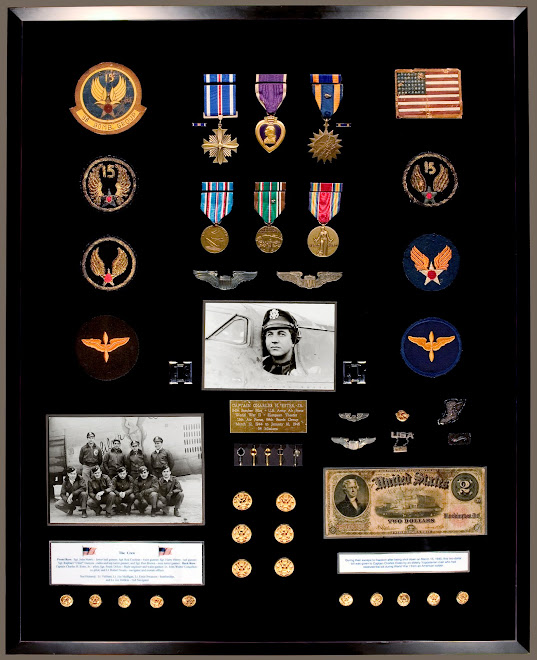
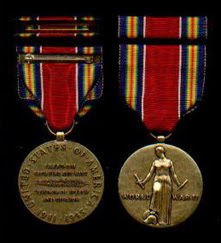
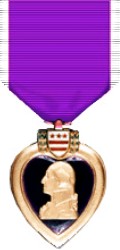
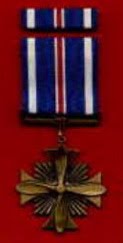
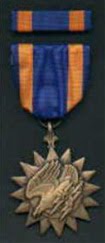
| Lt. Col. Congleton's war medals and scarf made by Yugoslavian women |
 |
| Bob Swain and John Congleton |
 |
Bob Swain, Charlie Estes and John (Little John) Congleton |
 |
| John casually resting on bombs |
Marian Congleton from
my Father.
(CLICK ON TO ENLARGE)

 |
 |
| Marian and John Congleton |
of Lt. Col. John Congleton in a manner
befitting a man who answered his country's
call to arms and continued to serve her
long after the war. It is a measure of
devotion for which we are all grateful;
it is because of such bravery we are able
to enjoy the freedoms we hold so dear.
Oliver Wendell Holmes wrote:
"At the grave of a hero we end, not
with sorrow at the enviable loss,
but with the contagion of his courage;
and with a kind of desperate joy we
go back to the fight."
John Congleton was a very special
and dear friend of my Father's. Long
after the war they remained close, and
even after his death, my Father continued
to stay in touch with Marian, his wife.
This posting has been especially personal
to me. I had been searching for Marian
for many, many months while blogging my
Father's war memoirs. I bet I called every
Congleton in the state of Kentucky! But...
my hard work paid off. She is a sweetheart
of a lady and I'm so very glad I found her and
consider her a dear friend.
I look forward to a time when I will
finally meet her.
Elizabeth Bacher